Wednesday, 14 December 2016

Herod’s Willing Accomplices: Celebrating Christmas in the Shadow of Aleppo


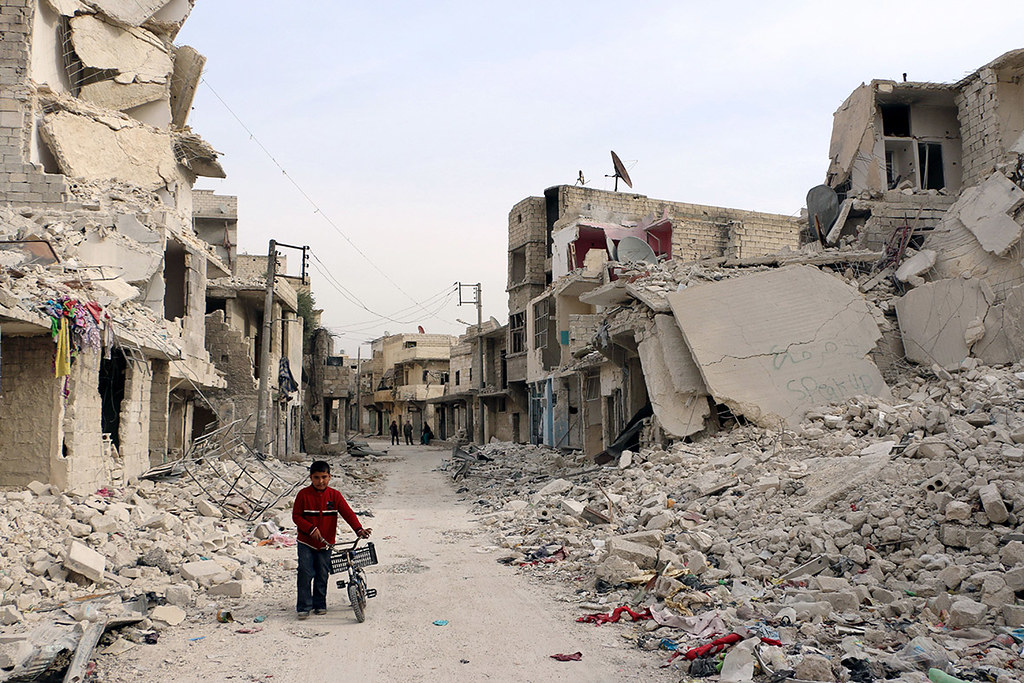
Image result for destruction of aleppo


Everyone has their breaking points, the moment when all consideration of decorum, diplomacy or dialogue, simply ends.


In 1994, Canadian diplomat Louis Gentle reached his.

Gentle worked in Banja Luka in Bosnia for the UN Commissioner for Human Rights.

The Serbian military, along with their Bosnian Serb paramilitary allies, were ploughing through the country in a storm of atrocity, ethnic cleansing, theft, rape, torture, and killing.

Gentle had been relaying reports to his superiors in Geneva and New York of events on the ground- horrific, pornographic events, as only events in the context of the former Yugoslavia’s disintegration could be horrific and pornographic.

He was beginning to get the impression that he was being ignored.

Every day, he looked his Bosnian Muslim neighbours in the eyes and tried to communicate that he knew, he understood, but that his position demanded that he observe, document, report, relay… but not take sides.

And it was making him spiritually sick.

Finally, on 14 January, he wrote a letter to the New York Times:


The terror continues, terror of attacks by armed men at night, rape and murder, children unable to sleep, huddling in fear behind boarded up doors and windows. The latest victims were three Muslim residents of the Banja Luka suburb of Vrbanja on December 29. In broad daylight, four armed men (two in uniform) entered the home of a couple, 58 and 54 years old. The man was shot in the head and killed, his wife was shot in the hand and then beaten to death with a blunt instrument. A Muslim neighbour, who had the courage and misfortune to inquire what was happening when the murderers left carrying a television set, was shot in the heart at point-blank range…

To those who said to themselves after seeing ‘Schindler’s List', “Never again”: it is happening again. The so-called leaders of the western world have known what is happening here for the last year and a half. They receive play-by-play reports. They talk of prosecuting war criminals, but do nothing to stop the crimes.

May God forgive them. May God forgive us all.

---


Banja Luka was over 30 years ago.

Aleppo is today.

And this is my breaking point.

The war in Syria, and dictator Bashar al-Assad’s brutal crackdown of those taking to the streets during the ‘Arab Spring’- remember the ‘Arab Spring’?-  crawls inexorably toward its sick conclusion.

Now, with the unlimited aid of the Russians and the silence of the American public- who just voted into office a man allied with the Russians and utterly indifferent to Assad- the end is all but inevitable.

And the city of Aleppo is being systematically killed off today. Today…

It seems both futile and absurd to try to convince people of the hell in which others are living; the very attempt just seems stupid, and I feel stupid doing it.

Aleppo is being destroyed, and everyone in the city is slated to die. The few remaining pockets of rebel-held areas endure shelling and airstrikes;

Doctors and other civilians continue to beg the international community to do something- anything- to stop the fighting.

They’re wasting their time, of course;

The ‘international community’ does not care. Actually, they can’t manage the effort to ‘not care’; they simply shrug. The most the Syrian people can hope for is that we’ll shrug in a mildly frustrated way…

They are trapped in a small area with no food.

(Jesus, could any American even imagine having no food? Not even Bread? Pringles?)

No water, no functioning hospitals…

What’s it like to have nowhere to go while your daughters broken leg goes septic on Monday, goes black by Wednesday, and she can’t speak with fever by Friday, is comatose by Saturday, and stops breathing Saturday night?

The last road out of the city has been continuously shelled. No one’s allowed to get out. Iranian-backed militias and Syrian regular forces- all with Russian weapons, intelligence, and endless aid- are going house to house, rounding people up, or summarily executing those they find.

Understand: the Syrian regime wants there to be no survivors. They want an historic victory over any and all who opposed them.

They want these people dead, publicly dead. And they’re killing them.

What’s it like to be waiting to die? What’s it like to have to choose between staying where you are and being killed by the shelling, or give yourself up to government forces and be tortured to death?

The UN is calling the situation a ‘meltdown of humanity’. The US ambassador to the United Nations, Samantha Power, told the Security Council late on Tuesday that the Syrian government, with unlimited aid from Russia and Iran, bore almost full responsibility for the rape of Aleppo. ‘Are you incapable of shame? … Is there no execution of a child that gets under your skin? Is there literally nothing that shames you?’

The short answer is no.


‘Save us, people. Save us, people, world, anyone who has even a bit of humanity. We beg you, we beg you, the dead and wounded are in the streets and people’s homes have collapsed on top of them. Save us. Save us.’

That was from a doctor still in the city.

‘I cannot leave because I’m medical staff which means a terrorist in the eyes of the regime. I cannot forgive. It is better that God takes my life than to live in humiliation under those who murdered most of my family and my neighbours, and destroyed my country and street and robbed my home.’

That was from a nurse. Her father and brother- both civilians- were killed by artillery shells within a few hours of each other. 

People have been posting farewell messages on social media. Abdulkafi al-Hamdo, a teacher, begged on Twitter for the international community to at least do something to save the remaining children in the city:  

I can tweet now but I might not do it forever. please save my daughter’s life and others. this is a call from a father. (This is) the last massage [sic]. Thanks for everything. we shared many moments. The last tweets were from an emotiomal [sic] father.
Farewell, #Aleppo.
---

Why am I writing this? Why am I writing this now?

Honestly, I hope to ruin your Christmas.

There’s nothing to celebrate. How can we celebrate the coming of Emmanuel – ‘God with us’- in the shadow of Aleppo?

Do we expect God to help the people there? When we won’t? When we won’t even make the pretense of helping?

How do we celebrate Advent and the words of the Hebrew prophet-

‘The people who lived in darkness have seen a great light…’-

When the only light in Aleppo is the glare of shell fire?

How can we celebrate the birth of Jesus when the majority of white American Christians voted for a man who made keeping Syrian refugees out of the US a campaign promise?

Every word, and every proposed policy and action of our President Elect and every man he thus far has put around him leads inevitably to the assumption that he read the Gospel narratives of Jesus’s birth and concluded that Herod was the hero…

Do those American Christians who voted to keep refugees of war and atrocity out of the US honestly believe that Jesus is alive? That Christ lives?

That he sees us?

That he was a refugee? That his parents fled a butchering dictator? That he grew up with the stories of other families who ran as well, as men with weapons went house to house, butchering children as they went?

After Christmas comes the Feast of the Holy Innocents, the solemn remembrance of Herod’s victims. But how can we remember them when we refuse to remember Assad’s?

Who would have the blasphemous audacity to praise the name of Jesus and support non-intervention when the atrocity that almost killed him happens again?

To even try is to make ourselves Herod’s willing accomplices.

How do you do that? Honestly, are you insane?

---


‘God’, wrote Mexican theologian Elsa Tamez, 'is not indifferent to situations of injustice. God takes sides and comes on the scene as one who favors the poor, those who make up the masses of the people... God identifies with the poor to such an extent that their rights become the rights of God: ‘He who oppresses a poor man insults his Maker, but he who is kind to the needy honors him’ (Prov. 14:31)...'

Tamez roots the theological struggle for liberation in a prophetic vision that God himself makes a choice. Latin American liberation theology called that choice a 'preferential option' for the poor.

Now, at this historical moment, a good chunk of American Christianity is opting for the diametric opposite.

They have opted for the well off, the influential, the famous, the healthy, the strong...

'We are not in favour of a God who lavishes affection on the lost and the lazy!’

‘We spurn this God who opts for those to whom we have decided to be ruthless!'

I'm not sure who they think they're worshiping, but make no mistake, it's not the God revealed in the person of Jesus. It's a very different god altogether...

That is idolatry. It is blasphemy. It is anti-Christ…

---


What do we do?

How do we do theology;

How do we do Western corporate, consumerist, capitalist Christianity;

How do we celebrate Christmas;

How do we shop for gifts, choose the latest gadgets, cook mountains of food, drink gallons of drink;

While the death squads kill everyone in Aleppo?

And even if they escape, we don't want them living next door to us? 

I don’t think we can.

I hope that we can’t.

Armenia. Auschwitz. Ayacucho. Mi Lai. Sabra and Shatila. Halabja. Banja Luka. Srebrenica. Rwanda. Darfur. South Sudan. Aleppo…

How many times can we say, 'Never Again’, before God condemns us as liars?

In the shadow of Aleppo, there is nothing to do but turn our celebration into mourning.

In the shadow of Aleppo, there is nothing to do but turn our fetish for God’s blessing into a spirituality of confession… of repentance… of conversion… of begging forgiveness…

Take your money and give it to the International Red Cross, Doctors Without Borders, Human Rights Watch…

The mercy of ‘Jesus the Refugee’, ‘Jesus the Survivor of Atrocity’, is our only salvation.

Renounce Herod. Be converted to God.

Embrace the God of life, liberation, and transformation.

We can no longer pretend. It’s criminal. It is blasphemous.

It’s got to stop…

Saturday, 3 December 2016

Doing Theology at Standing Rock...


Every Thanksgiving, Americans gather with their extended family and remind themselves of a day in 1621 when Pilgrim settlers, seeking a new life of liberty and religious freedom, celebrated in their new land and with a great abundance of food and the good company of their Native American neighbours.

(The actual history is much more difficult and complex than that simple national narrative, but…)

This Thanksgiving, I was on the Standing Rock Reservation in North Dakota, far away from my own family, but still with a great abundance of food and the good company of my Native American neighbours.

We were all of one mind and one purpose: to stop the ‘black snake’…

The ‘black snake’ is the what the Oceti Sakowin (pron. ‘Och-et-eeshak-oh-win’, the Sioux nations name for themselves) are calling the Dakota Access Pipeline (DAPL), a massive engineering project that begins in the Bakken oil fields in northwest North Dakota and travels in a more or less straight line through South Dakota and Iowa, and ends at the oil tank farm near Patoka, Illinois. 

It didn’t always follow the path it does; it was re-routed when residents of North Dakota cities Mandan and Bismarck objected, citing fears that the pipeline posed to a threat to their drinking water.
 
The re-routed pipeline now crosses lands ceded to the Oceti Sakowin by the Fort Laramie Treaty of 1851. Congress breached that treaty, though the Oceti Sakowin do not recognize any of the legislation that led to the treaty breach, and have refused all monetary compensations offered to them by the US courts for the land.

DAPL has brought all this history to a head.

The Standing Rock Reservation, next to these lands, has risen in protest against the pipeline. It is the latest chapter in their unbroken history of struggle for existence. They have been joined in solidarity by representatives of hundreds of Native American nations, as well as thousands of multi-ethnic and multi-faith allies. United around the slogan ‘Mni Wiconi’ (‘water is life’), they are keen to stress that this is not a protest and that they are not protestors…

They are ‘protectors’; ‘water protectors’, and this is about all of us…

They’ve been met with para-militarized police from 70 law enforcement agencies, as well as private security forces employed by the pipeline companies, armed with tear gas, attack dogs, rubber bullets, clubs, noise cannons, water cannons, and constant aerial surveillance…

I traveled out to Standing Rock with a friend and two of her children.


Why did I go?

There’s no doubt that both of us were conscious of the historic nature of the protector camps and were eager to be part of it. The election of Trump, I’ll be honest, hit me hard, and I’ve been feeling that actions are going to need to speak a lot louder than words for the foreseeable future.

I had to actually go, and when the opportunity arose, I jumped.

I had my own personal impetuses; part of it involved aspects of my Irish nationality;  

2016 is the centenary of the Easter Rising of 1916, when Irish nationalists staged a military occupation of Dublin in defiance of British rule. The political histories of Native Americans and of Ireland are quite divergent; nevertheless, in memory of the men and women of 1916- a history that has always meant a great deal to me- I wanted to in some way ‘rise’, albeit in a peaceful, non-violent, and constructive way, in solidarity with another people in defense of basic human rights, political self-determination, and cultural autonomy…

It’s also a decade since the people of Erris, in County Mayo in the west of Ireland, rose in protest against Shell’s plans to build a pipeline from the Corrib gas fields off the Irish coast through their land. Erris is an ancient area, and the people of Erris have  been on their land for centuries; they received no dividends or benefits from the pipeline, and had to bear the hypocrisy of the Irish government pushing through crippling austerity cuts to basic services (insisting the government was ‘broke’), all the while allowing a multinational oil corporation to loot our national resources, tax free, with utter impunity. I was always frustrated that I was unable to get out to Erris- from where my family name originates; The rising of the Lakota againt DAPL once again demonstrated that the stuggle for life and land is a global one; those who care for nothing but power and money want the whole world, and every people will need to rise against them…

Finally, there was the long history of the use of para-militarized police throughout Irish history- the RIC, the ‘Auxies’, the ‘Black and Tans’, the B Specials, the RUC- as a basic mechanism of social and political control;

To be blunt, if I see heavily-armed and armoured cops facing unarmed citizens, I don’t need to decide where to stand... 

But at bottom, I went to Standing Rock as a human being who wants nothing more than to resist what I see as the rising anti-ideology dominated by money, power, celebrity, and ‘no-nothing’ populism, and as a theologian seeking to be ever more connected with the struggle for the life and liberation of my neighbors and- as the Anglican liturgy beautifully describes it- ‘this fragile Earth, our island home’…


So what’s it like out there?

I was in the Oceti Sakowin camp. The population varies, but it varies around 4,000. We were camped on the banks of the Cannonball River, across from the Standing Rock Reservation.

The Oceti Sakowin camp is specifically a camp of prayer and ceremony. Life is rigorous and disciplined (you're wakened at 6am), as well as incredibly peaceful. That’s important to stress- the spirit of peace in the camp is overwhelming. At no point did I feel agitated or insecure. I left my wallet and credit cards in my tent and never gave them a second thought...

Everyone who enters the camp is strongly encouraged to attend orientation, which is basically a long and solid 90-minute boot camp. You are welcomed. You are told how important your presence is. No matter if you plan to stay for a day, a week, or indefinitely, your physical presence- and your part in the prayers of the camp- are valued.

Then, to business…

Respect the land. The land is sacred. Don't dig holes, and don't light your own fires;

Respect the sacred fires and council fire. Don't walk around fires anti-clockwise;

Don't walk between an elder and a fire if an elder is speaking;

Don't talk about conflict and violence around the sacred fires;

No alcohol or drugs on you or in you; again, the camp is a place of prayer and ceremony;

Be generous; share resources; look after those around you;

Be of use to the camp; volunteer for work details;

Don't confront police or DAPL private security on the roads, bridges or the drilling site. Don't carry weapons or anything that could possibly be construed as a weapon. Don't carry yourself in an aggressive manner;

No one is allowed anywhere near the 'front lines' (the bridge and the drilling site) or on an action without being fully checked in with the legal tent. Actions are meticulously planned on the camp's end, and it's vital that no one simply insert themselves into one; if you're arrested, you need to have all your legal info written on you arm in indelible ink, and legal needs to know where you are being held and on what charges (if any). This is not a game and it is not a riot; once again, the camp is dedicated to prayer and ceremony, and the actions are part of that;

Don't wear masks or cover your face; we are proud to stand; 

Don't spread rumours or fear;

Respect the elders;

Above all, keep everything in the camp indigenous-centric. The Lakota elders are the final word on all that goes on in the camp, and everything is designed to reinforce seven Lakota values: Prayer, Respect, Compassion, Honesty, Generosity, Humility, and Wisdom;

The camp is first and foremost a Native meeting and it’s a very big historical deal. It’s a meeting of the seven Sioux councils, the first since the Battle of Greasy Grass in 1876. It’s their place; the struggle against DAPL is their struggle, and they decide how it is conducted. If you are white, you are a very welcome guest, but listen before you talk;

Practice ‘decolonization’; don’t wear feathers or other Native sacred symbols; don’t call yourself by Native terms, like ‘warrior’, and unless you have been given a ceremonial name by Native elders, don’t presume to give yourself one;

If you are LGBT, don’t refer to yourself as ‘two spirit’; that is a Native term and has very specific understandings in their culture. Again, don’t appropriate Native ideas and symbols if you aren’t Native; trans people, if you identify as male, attend male meetings; if you identify as female, attend women's meetings. But when it comes to sacred fires or sweat lodges, if your body bleeds, follow the guidelines for women;

Don't take photos unless you are certified press;

Don't push your ideologies (Marxism, feminism, anarchism, LGBT, evangelism…). All are welcome, but the struggle of the Lakota people on their land is why you’re there;

Don't blast radios or stereos; again, the camp is a place of prayer and ceremony;

For that reason, women, wear long skirts;

Again, women, don't go near fires or sweat lodges if you're 'on your moon';

Above all, if you are white, step back. Defer to Native voices, Native opinions, and Native ways of doing things. Don’t argue, and don’t take it upon yourself to confront Natives.

And here’s where I’m going to get theological…


What did I take away from Standing Rock?

One of the key strategic values at Standing Rock is 'Bring it home'; the values, tactics, and methods of the camp need to be taken out into the wider world to not only spread the struggle, but to spread it with the same spiritual and strategic values of the Lakota people.

How do we bring this home? How do I, as theologian, draw reflection from this?

Here’s my reflection:

Some of those rules, values, and guidelines I mentioned above might seem petty, backward, maybe even insulting to some. ‘They call that a welcome?! What about equality? What about my personal freedom? What about my skills? And they want to tell me how to dress? I wear native gear to honour their culture! Why can’t they understand that? And I went on my own vision quest and decided to call myself “Warrior Girl”. What’s wrong with these people?!’

American whites- even liberal, progressive, or radical ones- have become very accustomed to being the final arbiters on all things political, cultural, and religious. It’s so natural to us, so completely subconscious, so entirely self-evident, that the idea of deferring to non-whites- even on their own territory- can be actually jarring to us.

Our desire to be understood, to explain ourselves, to stress how much we respect them, to convince non-whites of our good intentions are so strong, to talk and to talk and to talk and to talk…

We don’t know how exhausting it can be for others when all they want us to do is listen.

‘But we’re all brothers and sisters! Christ has made us equals!’

Blacks have never felt that. Latinos have never felt that…

And Native Americans have never, ever, ever, ever, ever, ever, ever felt that…

Oceti Sakowin Camp was about redressing imbalances, actively responding in an opposite spirit to racism, cultural appropriation, colonization, and ‘Manifest Destiny’.

Remember in the early '00s, during the anti-war/anti-globilization demos, when we all said, 'Another World is Possible'?

Welcome to 'Standing Rock'...

Latin American liberation theology called this making a ‘Preferential Option’; a change in attitudes and actions that seek to begin from the place of those who have historically been invisible, marginalized, overlooked, or actively repressed…

It might be a learning curve for some whites- a very steep learning curve… Some, like the wealthy young man who came to Jesus wanting to know how to be perfect, might actually go away sad, disillusioned, maybe even a bit angry.

In that case, I don’t think they loved Natives and Native culture nearly as much as they thought they did…

American Christians have talked endlessly about how they want to ‘be like Jesus’. It’s central to their very self-identity.

But again, conveniently, they make themselves the final arbiters of what it means to ‘be like Jesus’.

But in this Advent season, as we prepare for the coming of the ‘Light of the World’, I can think of no better example of what it means to ‘be like Christ’ than to do what Christ did in his gestation and birth:

Become human;

The Greek term for this is ‘Kenosis’ (κένωσις)- the Son of God, the second member of the Triune Godhead, emptying himself of that essential Divinity- the ultimate, universal ‘privilege’- and becoming human, becoming a human life completely receptive to Divine will;

Just to demonstrate that is was possible…

Christ’s ‘Kenosis’ is the beginning of human salvation, and, as St. Paul insisted, it is the ultimate mark of a Christian. As he encouraged the early Church:


Instead of being motivated by selfish ambition or vanity, each of you should, in humility, be moved to treat one another as more important than yourself. 
Each of you should be concerned not only about your own interests, but about the interests of others as well. You should have the same attitude toward one another that Christ Jesus had,
Who, though he existed in the form of God, did not regard equality with God as something to be grasped,
But emptied himself, by taking on the form of a slave, by looking like other men, and by sharing in human nature.
He humbled himself, by becoming obedient to the point of death —even death on a cross…

This is the central theological plank in the life of Christ: that he emptied himself, ‘made himself nothing’, became a servant…

Oddly, in the wake of the Presidential campaign and subsequent election, a good portion of American Christianity has been seeking exactly the opposite. 

Wealthy, Christian white men jockey for influential cabinet positions and advisory appointments.  Many white Evangelicals- who voted overwhelmingly for the President-Elect- are bullish about the future, seeing their agenda as becoming ascendant…

But when asked what exactly that ‘agenda’ involves, they talk about Second Amendment rights; aggressively targeting immigrants and Muslims for deportation; Showing the rest of the globe who’s boss; keeping Mosques out of their towns; putting Creationism into public schools, stridently saying ‘Merry Christmas’; more influence in Washington; more freedom for ‘them’ and less for gays; keeping transgender people out of ‘their’ bathrooms, ‘their’ schools, ‘their’ public places…

When they proudly talk about making ‘America great again’, they hark back to decades that many of their non-white and non-Christian neighbors remember as nightmarish;

The legislation, protections, and benefits that they lament as ‘public policy disasters’ and now aggressively talk of rolling back- or abolishing altogether- are seen by many of their non-white and non-Christian neighbors as vital landmarks in a long struggle for basic equality and justice…

In short, a majority of white Christians are not seeking to ‘empty themselves’ for the good of others but to fatten themselves in spite of others.

This is the antithesis of Christianity.

This is not simply un-Christian; it is anti-Christ.

I’m a white Christian male. I never felt demeaned, looked down upon, or resented at Standing Rock. I had long and deep conversations with my Native brothers and sisters. We were one in a struggle. They asked questions about Ireland and Irish culture, noted similarities and differences spoke of common struggles and shared humanity. We laughed. We were somber. We shared with each other- food, money, wood, water, tobacco…

When I told friends and colleagues I was heading to Standing Rock, several commented about how useful my post-conflict and reconciliation expertise would be.

At Oceti Sakowin Camp, I realized that to be like Jesus was to empty myself, as he did;

Not to think of my wants, desires, expertise, talents- how I was sure I could be of good use, but to ask what had to be done, get stuck in and be of use.

This is the ‘kenotic’ ethic, this radical Gospel of ‘emptying’ that will need to be cultivated in the days, weeks, months, and years to come, like a fragile plant in a cold wind…

It is all that will save us from the ‘black snakes’ that are becoming more and more aggressive;

It is the only thing that will truly unite us as people, as Americans, as global peoples of all faiths seeking to live together well.

This is the message of Advent…

This is the struggle…

---

A final story:

When I asked what needed to be done around the camp, one suggestion was collecting rubbish. I found out that one of the tactics of the Army Corp. of Engineers to shut down the camp was to declare us a disaster area and a public health hazard, so keeping the acres of ground tidy was absolutely essential. Not a cigarette butt, not a bottle cap, not a piece of plastic should be left lying on the ground; the land is sacred, and our enemies would use any of it against us. Young Lakota volunteers in pickup trucks drove around collecting rubbish, and I picked up a bin liner and walked around the camp collecting things off the ground. I found it was a great way to see the whole camp;

It evolved into very personal discipline;

It evolved into a very personal form of prayer;

I finally understood what they meant when they said the camp was a place of prayer and ceremony…

As I walked around, I prayed the Our Father, the Hail Mary, the Gloria Patri…

I sang ‘Óró, sé do bheatha 'bhaile’, a traditional Irish song of resistance:

Óró, sé do bheatha bhaile, 
óró, sé do bheatha bhaile, 
anois ar theacht an tsamhraidh…

Oh-ro, welcome home, 
Now that summer's coming…

Natives would walk by. ‘Hey, thank you for doing that, brother. Thank you...’

I’d rarely felt as welcome or as at home in my life…

and though it was bitterly cold, Summer would come;

It always does…